The four jobs this software has
Strip away the feature lists and qualitative software does four things. It gets spoken words onto the page. It holds your codebook steady so a code means the same thing in week six as it did in week one. It lets you look across the whole corpus instead of one transcript at a time. And it keeps a record of how the analysis was made, so the findings can survive a question.
Everything else is arrangement. The four jobs are the work.
STAGE ONE
Getting the words on the page
Transcription is the tax on qualitative work. It is also the point where most studies hand their most sensitive material to a stranger, because the recording goes to a service, sits on a server, and comes back as text.
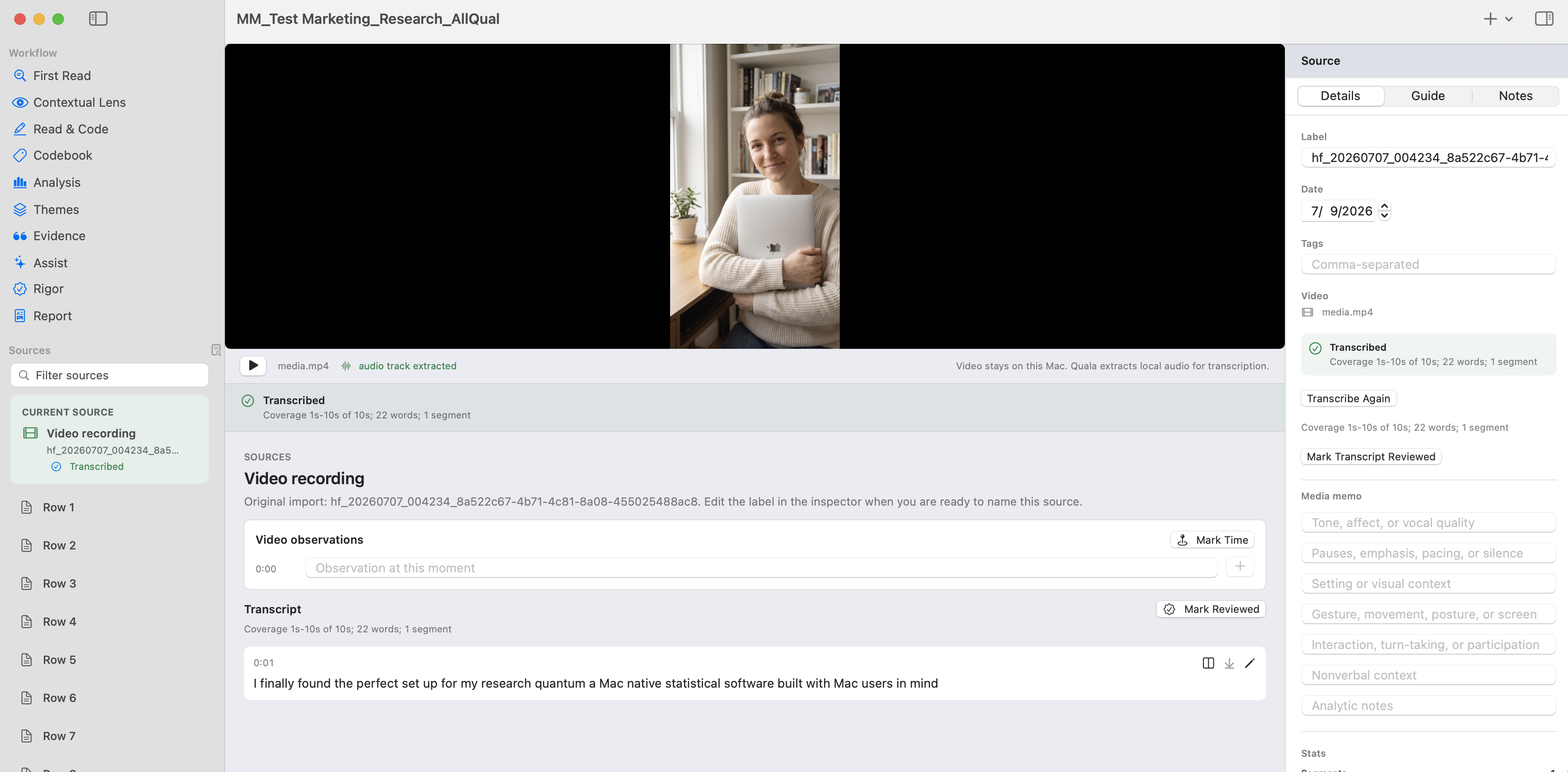
Quala transcribes on the machine in front of you, using Apple's on-device speech frameworks. The recording stays put, the transcript stays put, and there is no per-minute bill and no third party holding a copy. For IRB-covered interviews the consent conversation gets simpler, because the honest answer to "where does the recording go" is one sentence long.
STAGE TWO
Coding that holds its shape
The failure mode in a long study is drift. A code that meant one thing in the first five interviews quietly means something wider by the twentieth, and nobody notices until the write-up will not hold together.
A codebook fixes this only if it carries definitions rather than labels. In Quala every code holds its own definition and its own examples, memos attach to the excerpts that prompted them, and the codebook is the single source of truth for the project rather than a document you meant to update. ReliCheck Intelligence can suggest codes drawn from that codebook, and it never applies one on its own. The judgment stays yours, and the audit trail records that it was yours. When more than one analyst is coding, the drift problem doubles; The Signal covers how to get two analysts to see the same thing.
STAGE THREE
Seeing the whole corpus at once
This is the part a highlighter cannot do. Qualitative analysis asks questions that only make sense across the full set: what came up, where it came up, who said it, how often, and in whose words. Answering those by hand across thirty transcripts is where the hours go, and where the inconsistencies get in.
Quala's analysis views answer those questions directly, and a quote bank holds the strongest evidence ready for the moment you sit down to write. The passage you remember hearing is a search away instead of an afternoon away.
STAGE FOUR
Findings that can take a question
A committee member asks how a theme earned its place. A reviewer asks what counted as evidence. A colleague asks whether a second coder would have seen the same thing. These are fair questions, and answering them from memory is uncomfortable.
Trustworthiness tools and an append-only audit trail record how the analysis was built as you build it. Word export arrives formatted, and a coded transcript pasted into a manuscript keeps its highlights and code tags. When the study has a quantitative strand too, one click hands the qualitative side to MM Studio.
CAQDAS: what computer assisted qualitative data analysis software actually has to do
You will see the category called CAQDAS, computer assisted qualitative data analysis software. The term goes back to the 1980s and the emphasis in it is worth keeping: assisted. The software does not interpret your interviews. It holds the evidence in order so that your interpretation rests on something a reader can follow.
Working on a Mac
The four jobs above are the same whatever machine you run them on. What changes on a Mac is where the work happens: Quala is written in Swift for Apple silicon, so transcription runs on the machine in front of you rather than on someone else's server. That is a separate question from what the software has to do, and it has its own page: qualitative analysis software for Mac.
Where Quala sits
Quala is built for the applied researcher with twelve to thirty interviews and a date on the calendar. It is one of three Mac-native research apps from ReliCheck, alongside Quanta for statistics and MM Studio for mixed methods.
Thirty days free, then $9.99 a month or $79.99 a year. One price for everyone, students included.