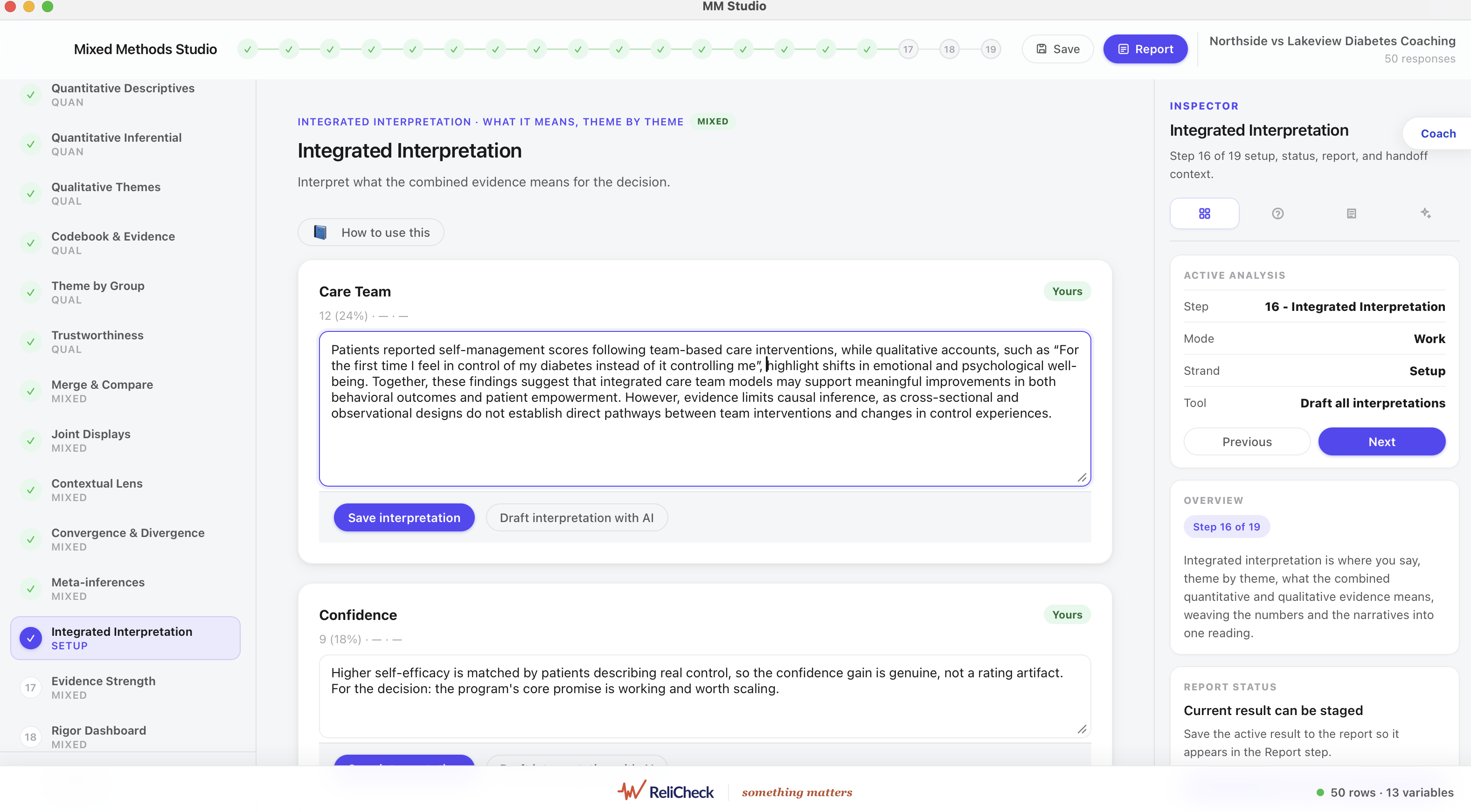
Integration as the foundation
Most tools treat mixed methods as two separate analyses stapled together at the end. In MM Studio, eight of the nineteen workflow steps are integration steps. The numbers and the narrative meet early and keep meeting, so the joint story is built, not reconstructed.
When a null result still has to mean something
A trial comes back with no difference between conditions. On its own that finding has two readings and no way to choose between them: either the program does not work, or it was never delivered the way it was designed. Those point to opposite recommendations, and a single strand cannot tell them apart.
A second strand can. Observations and debriefs establish whether the thing being tested actually happened, which is what makes a null interpretable instead of merely disappointing. MM Studio keeps that strand attached to the trial rather than filed beside it, so the fidelity evidence sits in the same project as the estimate it explains.
Joint displays that carry the argument
Pair a quantitative result with a qualitative theme and record what they mean together: where the strands converge, where they diverge, and where one expands the other. The divergences are kept in view rather than smoothed over, because they are usually the most informative part of the study and the easiest to quietly drop.
Evidence strength, stated rather than implied
Every cell in a joint display carries an evidence-strength rating. The effect of that is small and specific: it forces each integrated claim to say how hard it can be leaned on, one claim at a time, while the evidence is still in front of you.
This is the discipline that separates integration from adjacency. A discussion paragraph asserting that the strands converge is easy to write and hard to defend. A display where each pairing carries a rating is harder to write and answers the committee question before it is asked.
Convergent, explanatory, and exploratory mixed methods designs
Convergent, explanatory sequential, and exploratory sequential designs are first-class choices, and the workflow adapts to the one you pick. The methodology a committee expects to see is the structure the software actually enforces.
| Design | The question it answers | How you know it is yours |
|---|
| Convergent | What do two independent readings of the same situation show, and where do they disagree? | Both strands run in the same window. Neither waits for the other. |
Explanatory
sequential | You have a result. What accounts for it, and for the variation inside it? | The quantitative findings choose who gets interviewed. |
Exploratory
sequential | No existing instrument measures this well. What should it measure? | The qualitative strand produces the instrument the survey then uses. |
An APA-ready integrated report
The report builder assembles findings, joint displays, and meta-inferences into a document formatted for the manuscript, so the integration chapter stops being the one you dread writing.
From the field to the finding
The free MM Field Studio iPad app collects each rating with the explanation behind it, consent-first, and hands complete cases to MM Studio on the Mac. Quantitative strands can come from Quanta and qualitative strands from Quala, all part of the ReliCheck ecosystem.
Native on the Mac, present everywhere
MM Studio runs native on Apple silicon, works in the browser when you are away from your Mac, and analysis runs locally. Your study does not need to live in a cloud to be a modern study.