Built for the Mac, not ported to it
Quanta is written in Swift and engineered for Apple silicon. The statistics engine runs on Apple's math frameworks directly, with no R, Python, or translation layer underneath. It opens fast, follows macOS conventions, supports dark mode, and feels like software that belongs on the machine, because it was built for it. The Signal has the longer story of how the Mac grew into a serious research machine, and takes on the advice students still hear in why "use Windows for statistics" stopped being true.
From descriptive statistics to SEM, and beyond
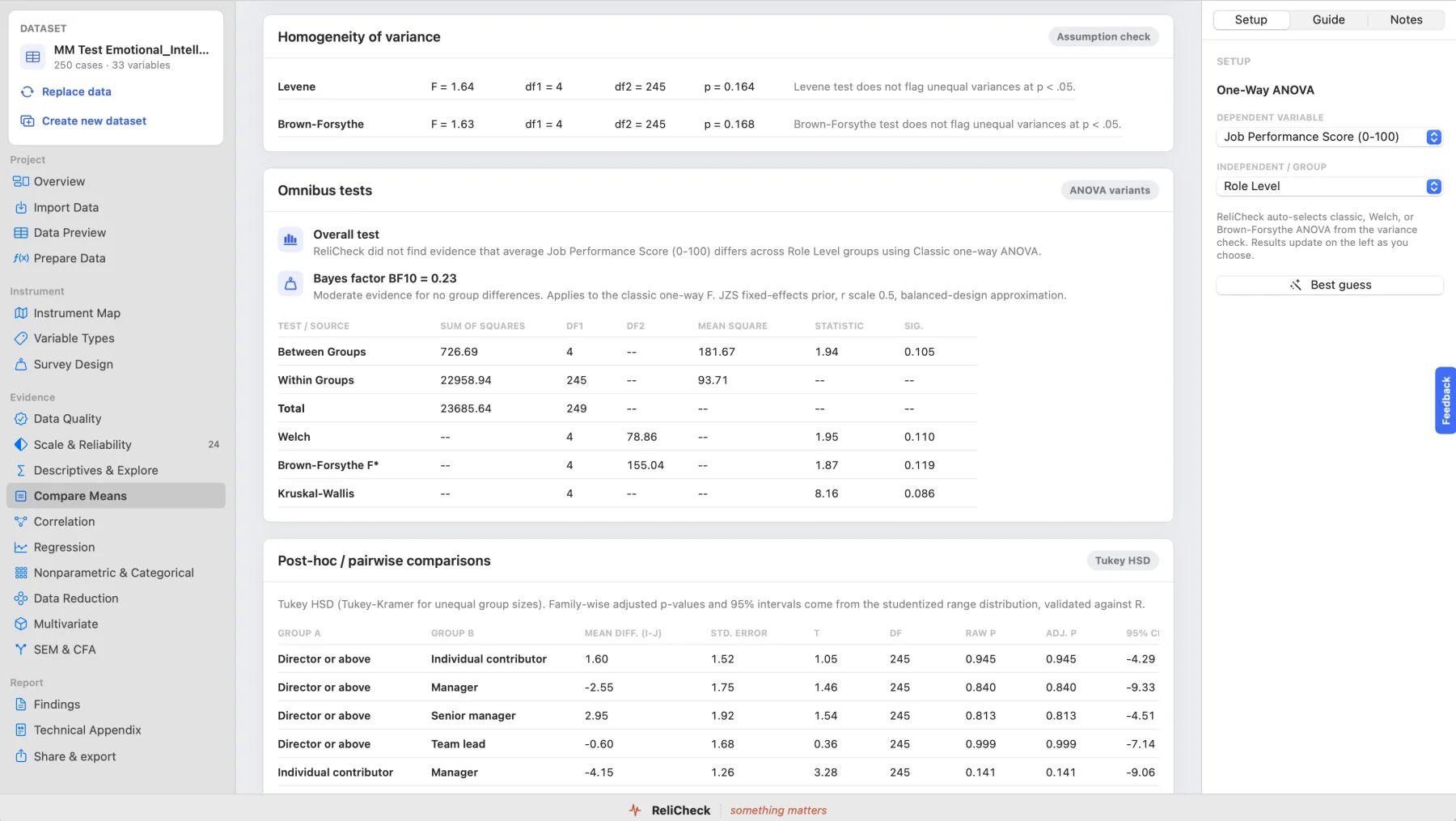
Quanta covers the analyses behavioral and health researchers actually run: descriptives, t tests, ANOVA and ANCOVA, correlation, regression, factor analysis, reliability, missing-data imputation, and structural equation modeling with CFA. Frequentist results and Bayes factors print side by side, so a study that found nothing can say how strongly it found nothing. An Advanced tier ($179/year) adds multilevel models, generalized linear mixed models, latent class and profile analysis, finite mixture models, survival analysis, mediation, moderation, and measurement invariance.
Quanta's safeguards are contextual recommendations, not restrictions. The software surfaces the analyses that fit your study design, runs robustness checks alongside the primary test, and flags assumption problems on the result, and every test remains available for you to run.
Representation checks no other workflow builds in
Before you trust an analysis, Quanta asks a question most statistical software never asks: who does this data actually represent? Missingness by group shows whether nonresponse fell evenly across groups or quietly removed one community from your results. Sample vs population tests your sample's composition against the benchmarks you provide and names which groups are over- or under-represented. Grouped descriptives flag small groups rather than collapsing them, so no group disappears from the table. These checks live in Data Quality, in the base app, because who your findings describe is not a premium question.
Made for survey data
Import CSV, Excel, Apple Numbers, or exports from Qualtrics and Google Forms. Run scale reliability with Cronbach's alpha and item-total diagnostics, check group differences, and keep every step attached to the dataset it came from.
Publication-ready output
Every analysis produces APA 7 formatted tables and an editable findings report, so the hour of reformatting between the output window and the manuscript disappears. Charts export alongside the numbers they describe. The Signal covers why the revision cycle, not the first draft, is the real formatting cost.
Accuracy you can verify
Statistical software earns trust by being checkable. Quanta's engine is validated against NIST reference datasets and published statistical standards, and the validation record is part of the product, not a marketing line. We wrote up why Quanta runs on the CPU and what that choice does for accuracy.
Private by architecture
Analysis runs on your Mac. Your data never uploads to a server, and the network is used to confirm your subscription. For IRB-covered work, that is an easy sentence to write in a data management plan.
Part of the ReliCheck ecosystem
Quanta is one of three Mac-native research apps from ReliCheck, alongside Quala for qualitative analysis and MM Studio for mixed methods. Findings from Quanta travel to Findings Studio on iPad when it is time to present them.
How Quanta compares
Most people arriving here already use something else, and the honest question is whether switching is worth it. These go through it one package at a time, including the cases where the answer is no.
If you are bringing existing work across, Quanta opens .sav files directly.